
Small enough to forget. Honest about what it measures.
One hardware platform behind both Epile-X and Neo, designed, built and tested in-house.
Two modules, one recording
The wearable is two independent modules, one behind each ear. Each has its own EEG front end, processor, motion sensor, storage and battery. Only a thin band joins them, carrying the shared reference and a common clock.
The shared clock means both sides sample at exactly the same instant, so the two halves line up sample for sample with no syncing tricks. Detection and analysis run off the device, where models can be larger and updated freely.
Many signals, one picture
EEG comes first. Every other sensor is recorded on the same clock, so fusion algorithms can use each one to check the others: removing artefacts from the EEG, and telling real events from everyday interference.
EEG
Electrodes around each ear, sampled at 250 samples per second with 24-bit resolution.
Motion
An inertial sensor in each module tells movement, posture and sleep position apart.
Heart & breathing
Optical sensing (PPG) for heart rate and related signals.
Skin & temperature
Skin conductance, skin temperature and humidity.
Sound
A microphone to help recognise chewing and talking, the main sources of interference.
Event button
One press to mark a moment, so the wearer’s own experience is part of the record.
Reconstruction: from two points to a fuller picture
Two behind-the-ear sites cannot match a 20-electrode cap on their own. So we record both at once, a full research cap and our wearable, and train models such as variational autoencoders to learn the mapping. The models reconstruct virtual scalp channels from the ear sensors plus body signals, and estimate which side and region activity starts in, a little like triangulation.
This needs paired training data, and some sources (deep or frontal) stay hard to reach from the ear. How far reconstruction can go is a question our studies are built to answer.
Hardware generations
Engineering prototype
Our first board: two independent modules, a few hours of battery, live streaming to a laptop dashboard.
Wearable prototype
Electrodes placed where our montage study says they work best, a full day and night of battery, easy-swap electrodes.
Research-grade
A lower-noise analogue front end, at the level needed for scientific and clinical studies.
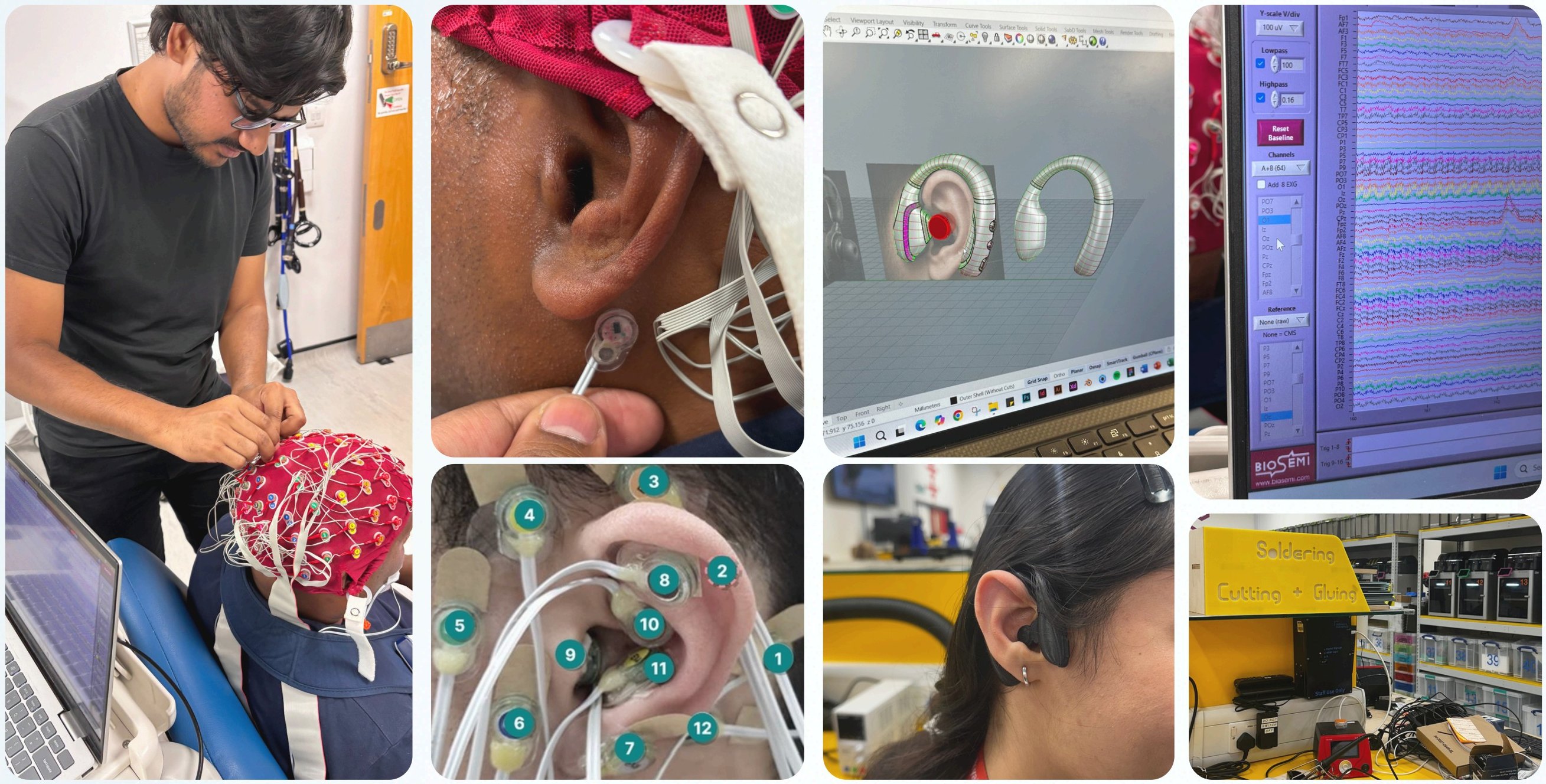
How we test
- Against a reference. Ear recordings are compared with research-grade EEG worn at the same time.
- Against real life. Chewing, talking and walking are the hardest interference for ear EEG, so we test against them on purpose.
- With a report. "It works" means there is a written protocol and a filled-in test report.